



The integration of revolutionary AI technologies is a fundamental trigger for organizational grief, guaranteeing the profound disruption of the corporate status quo. To expand the article’s discussion on AI-driven transformation, the established psychological frameworks—such as the Bridges Transition Model and the concept of disenfranchised grief—can be directly applied to the specific anxieties generated by artificial intelligence.
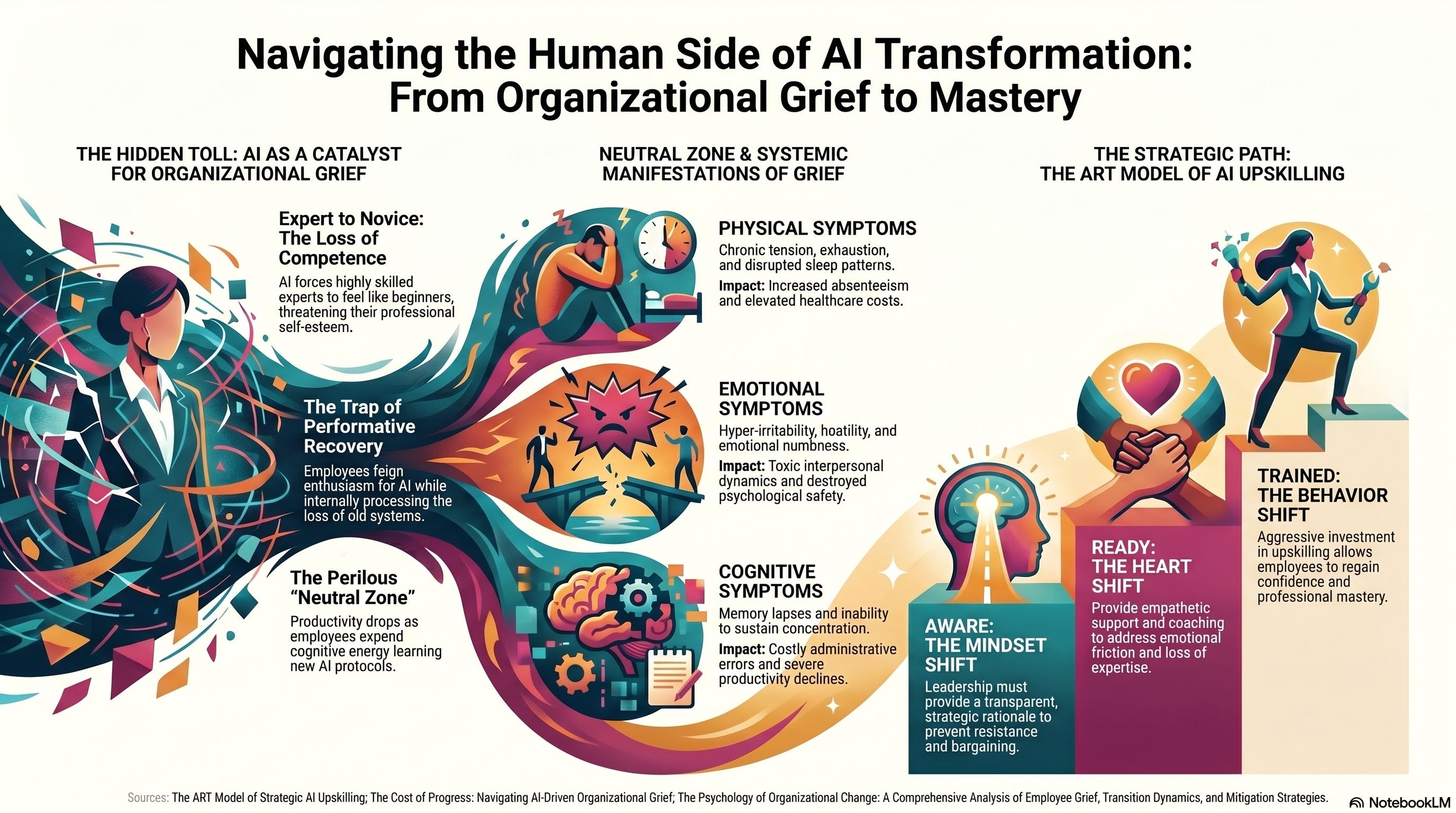
The Threat to Professional Identity and Competence The deployment of AI systems abruptly forces employees into the “Endings” phase of the Bridges Transition Model by initiating a sudden Loss of Competence. When an organization mandates the adoption of newly automated AI-driven systems, highly skilled and tenured employees are forcibly moved from a state of mastery back to a state of novice. For example, a director who has spent years mastering highly complex legacy workflows may suddenly feel like an incompetent beginner, rendering their hard-won historical expertise obsolete and deeply threatening their professional self-esteem. This directly triggers a severe Loss of Identity, as employees frequently define their core professional value through the specific, specialized roles that an AI system may alter or dissolve.
AI as a Catalyst for Disenfranchised Grief The corporate mandate to adopt AI is often championed as an exciting milestone or mandatory progress, which actively exacerbates disenfranchised grief. Because modern corporate culture is rooted in continuous productivity, any overt sorrow over a discontinued software platform, a dissolved legacy workflow, or a loss of manual expertise is viewed as deeply unprofessional. When AI integration is framed as purely positive, employees are subjected to performative recovery. They are intensely pressured to feign enthusiastic support for the new AI rollout long before they have cognitively processed the loss of the old system, which leads to unexpressed pain, emotional exhaustion, and eventual turnover.
Furthermore, older workers face an elevated risk of disenfranchisement during rapid digitalization or AI adoption; management may operate under the biased assumption that their resistance is simply due to an inability to learn, completely failing to acknowledge their profound grief over the invalidation of their decades of analog expertise.
Navigating the AI Neutral Zone During the implementation of AI, employees are thrust into the chaotic and anxiety-inducing Neutral Zone, where legacy rules no longer apply and new technical protocols are not yet fully understood. Normal operational productivity drops catastrophically because employees expend immense cognitive energy merely attempting to learn the new AI workflows and making inevitable mistakes.
To safely manage this AI transition, leadership must utilize structured interventions like the ART (Aware, Ready, Trained) model:
Aware (The Mindset Shift): Leadership must transparently communicate the strategic necessity of the AI integration. Without understanding this rationale, employees will stubbornly attempt to bargain their way back to comfortable legacy systems.
Ready (The Heart Shift): Leaders must openly validate the fear and loss of professional competence. Using precise, empathetic language to acknowledge that transitioning to AI forces the loss of relied-upon workflows dismantles the stigma of organizational sorrow and creates psychological safety.
Trained (The Behavior Shift): Because anxiety peaks when employees feel useless in the new paradigm, organizations must aggressively invest in comprehensive upskilling. Providing specific technical training on the newly automated AI-driven systems is required for employees to regain their professional confidence, transition out of the Neutral Zone, and proactively engage in a “New Beginning”
.


